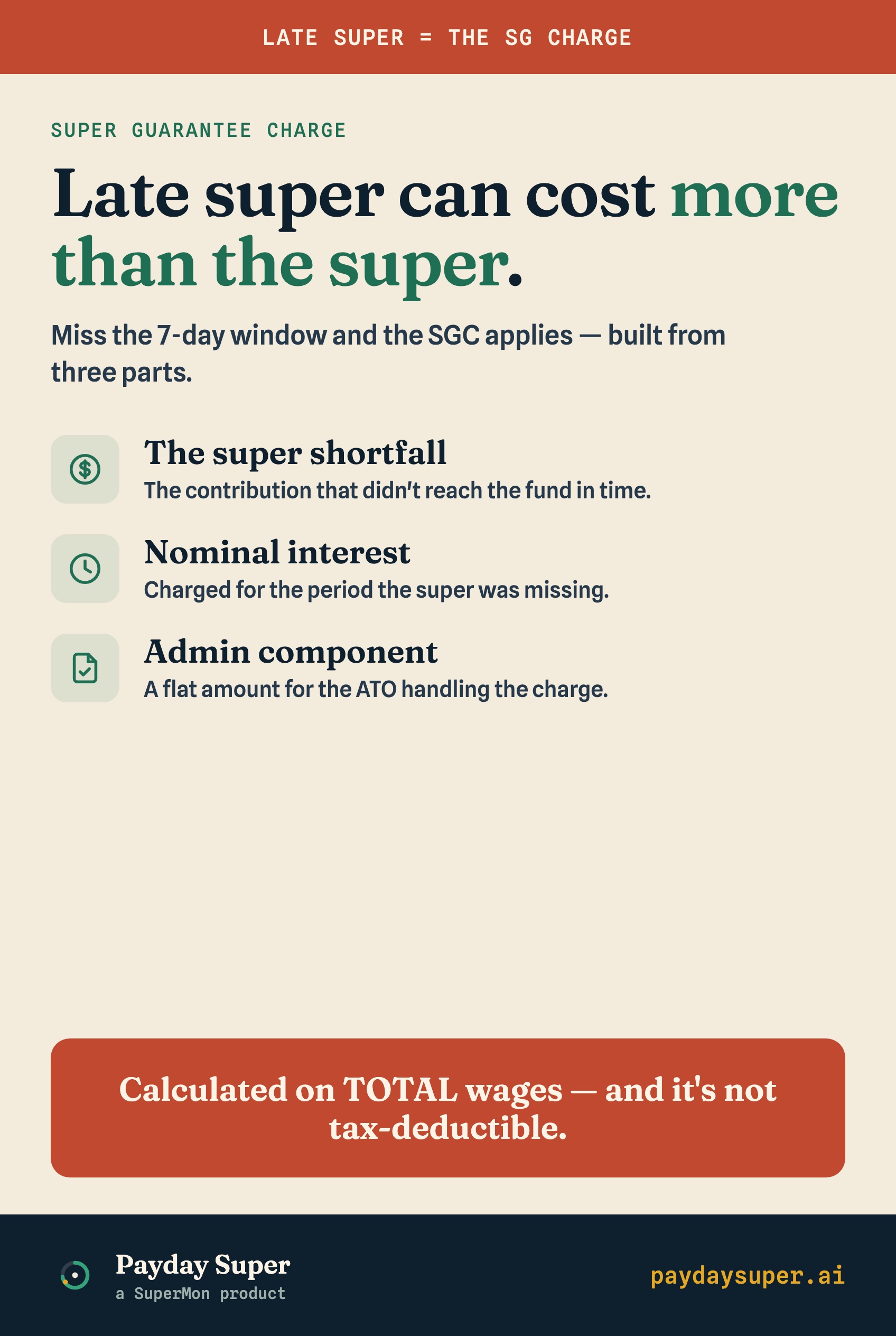
If super reaches an employee's fund late, you don't just pay the super you missed. You pay the Super Guarantee Charge — and it can cost more than the contribution itself.
That matters more from 1 July 2026 than it ever has. Payday Super requires Super Guarantee (SG) contributions to be received by each employee's fund within 7 business days of payday. The old quarterly window is gone. Every pay run now carries its own deadline, which means there are far more chances to be late, and far more chances to trigger the charge.
Here's exactly what the SGC is, why it bites harder than people expect, and how to stay clear of it.
What is the Super Guarantee Charge?
The Super Guarantee Charge (SGC) is what you owe the ATO when SG contributions aren't paid in full and on time.
It is not the same thing as the super itself. It is a separate charge you report and pay to the ATO, and it is built from three components:
- The super shortfall — the SG amount that should have reached the fund but didn't, or arrived late.
- Nominal interest — interest that compensates for the period the employee's super was missing.
- An administration component — a flat amount that covers the cost of the ATO handling the charge.
The SG rate itself hasn't changed. It's still 12% of ordinary time earnings (OTE). Payday Super changes when you pay, not how much or how. What changes with the SGC is that a timing slip turns a routine 12% contribution into something larger and messier.
Why does the SGC often cost more than the super I owed?
Because of two things people miss.
First, the shortfall part of the SGC is calculated on total salary and wages — not just OTE. Ordinary super is worked out on OTE, which excludes some payments. The SGC shortfall uses the wider base. So the amount the charge is built on can already be bigger than the super you were trying to pay.
Second, the SGC is not tax-deductible. Normal SG contributions paid on time are deductible. The moment a payment becomes an SGC, you lose that deduction — and you've added nominal interest and an administration component on top.
Put those together and a late payment can comfortably exceed what an on-time contribution would have cost.
One caution: the exact nominal interest rate and the size of the administration component are set by the ATO and change over time. Don't rely on a figure you read somewhere last year. Confirm current rates and amounts against current ATO guidance before you calculate anything.
How is the SGC different from paying super on time?
The contrast is the clearest way to see why timing is everything now.
| SG paid on time | Super Guarantee Charge | |
|---|---|---|
| Calculated on | Ordinary time earnings (OTE) | Total salary and wages |
| Tax treatment | Deductible | Not deductible |
| Extra costs | None | Nominal interest + administration component |
| Paid to | Employee's fund | The ATO (then directed to the fund) |
| Reporting | Standard payroll / STP | Separate SGC statement to the ATO |
Same employee, same pay run. The only variable is whether the contribution reached the fund inside the 7-business-day window. That single fact decides which column you're in.
What's the actual deadline I'm working to?
Super must be received by the employee's fund within 7 business days of payday.
Read that twice, because two words do most of the work:
- Received, not sent. The clock stops when the money lands in the fund, not when it leaves your account or your clearing house. Processing time between you and the fund counts against you.
- Business days. Weekends and national public holidays don't count, but they don't extend your real-world cushion either. A Friday payday heading into a long weekend gives you less calendar room than it looks.
Single Touch Payroll (STP) ties into this. Every pay event you report to the ATO effectively starts a 7-business-day super clock for that pay run. The reporting and the deadline are now linked.
For earnings paid up to 30 June 2026, the old quarterly rule still applies — SG due 28 days after the end of the quarter. Payday Super applies to salary and wages paid on or after 1 July 2026. Don't mix the two up during the changeover.
How do I avoid the SGC under Payday Super?
You avoid it by making sure money lands in the fund on time, every pay run. Here's the practical checklist.
- Build in a timing buffer. Don't aim to pay on day 7. The contribution has to arrive by then, and you don't control how fast the fund processes it. Pay early enough that normal processing still lands inside the window.
- Replace the SBSCH now. The Small Business Super Clearing House closes 30 June 2026. If you or your clients have relied on it, you need a commercial alternative in place and tested before your first July pay run — not after.
- Validate fund details before payday. A wrong fund or member number bounces the payment, and a bounced payment is a late payment. Check super fund details, USIs and member numbers are current, especially for new starters.
- Watch every payday's deadline. With pay runs at different frequencies across different clients, the deadlines stack up fast. Track each one and act before it's close, not after it's passed.
- Fix shortfalls the moment you spot them. If something was missed, correcting it quickly is always better than waiting. It limits the nominal interest and reflects the genuine-compliance behaviour the ATO's first-year guideline (PCG 2026/1) is looking for. That guideline softens how the ATO engages — it does not remove the obligation or the charge.
Keeping ahead of the deadline
The hardest part of Payday Super isn't understanding the rule. It's that there's now a deadline attached to every single pay event, across every client, every pay cycle — and the cost of missing one is a charge that can exceed the super itself.
That's a monitoring problem more than a payroll problem. SuperMon connects to Xero today (read-only — it reads pay runs, it can't move money or change payroll), with MYOB coming soon. It tracks each client's 7-business-day deadline and alerts you before anyone is late, so a missed payday doesn't quietly become an SGC. The goal is simple: stay in the on-time column, every time.