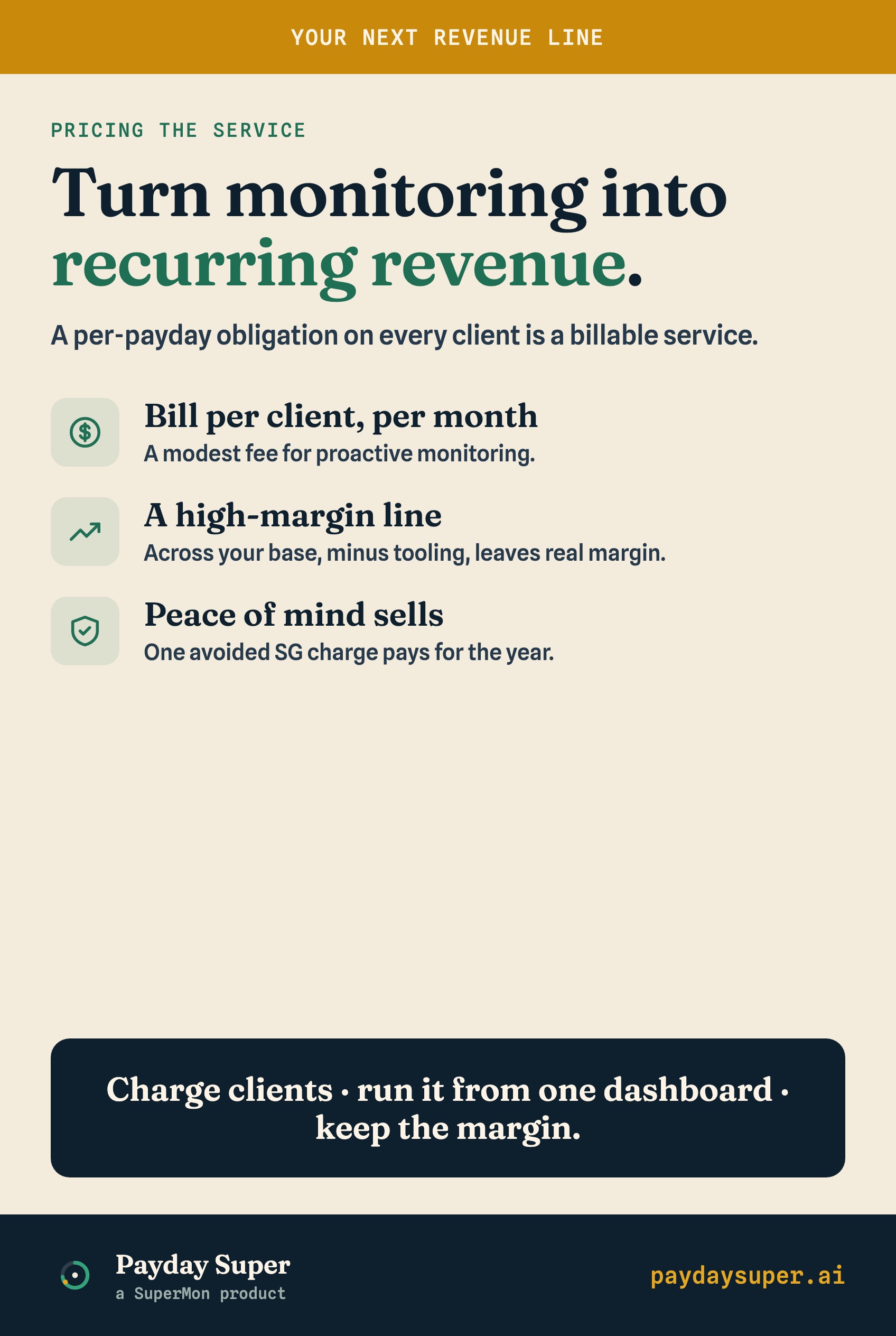
Payday Super hands your practice a new recurring obligation on every client: confirm their Super Guarantee reaches each employee's fund within 7 business days of every payday. That work recurs forever, and missing it carries a real penalty. Recurring work with downside risk is exactly the kind of thing a practice can price and bill as a service.
This briefing is about the pricing decision specifically. How much to charge, which model to use, and what margin to expect once you subtract the cost of the tooling that makes it deliverable.
Why is Payday Super monitoring a billable service?
Because the obligation is continuous and the cost of getting it wrong is concrete.
From 1 July 2026, every payday starts a 7-business-day clock for super to be received by the fund. Not sent — received. Miss it, and the client is exposed to the Super Guarantee charge: the shortfall, plus nominal interest, plus an administration component. The charge is not tax-deductible, and it's calculated on total salary and wages rather than just ordinary time earnings, so it can land higher than the super that was owed in the first place.
That combination is what makes monitoring billable. You are not selling data entry. You are selling assurance against a deadline that now resets on every pay run and carries a penalty most clients can't afford to discover the hard way. One avoided charge pays for years of the service.
What are the pricing models?
There are three that practices actually use. Pick based on how your book is structured, not on what sounds clever.
Flat per-client monthly fee. One price per client on your engagement letter, billed monthly. Simplest to quote, simplest to explain, simplest to add to a client who already trusts you. Best when your clients are broadly similar in size and pay cycle.
Tiered by payroll complexity. Different prices for different risk profiles. A stable monthly payer costs you almost nothing to watch; a weekly payer with high staff turnover and stapling churn is more work and more risk. Tiering lets the fee track the actual exposure. Best when your book is mixed.
Bundled into existing packages. Fold monitoring into your bookkeeping or payroll package and lift the package price. Lowest friction — there's no separate yes required. The downside is the work becomes invisible, so the client never sees what they're paying for and may push back at renewal. Best when you already run the client's payroll end to end.
A practical hybrid: bundle it for clients whose payroll you fully manage, and offer it as a named line to clients who run their own payroll and just need a watch on the deadline.
How should I tier the fee by complexity?
Anchor the tier to the work and the risk, not to a round number. Pay frequency is the cleanest proxy for both.
| Tier | Typical client | Why the fee differs |
|---|---|---|
| Standard | Monthly payer, stable staff | Few deadlines per period, low churn, low risk |
| Higher | Fortnightly payer, some turnover | More deadlines, more fund details to keep current |
| Managed | Weekly payer, or payroll you run | Most deadlines, highest exposure, you own the workflow |
The point of the table isn't the labels. It's that a weekly payer hits the 7-business-day deadline far more often than a monthly payer, so there's more to watch and more chances to slip. Pricing that flat leaves money on the table at the top and prices you out at the bottom.
What margin can I actually expect?
Here's a worked example for a practice billing a flat per-client fee.
- Bill 40 clients at $49 per client per month → $1,960 per month in monitoring revenue.
- Subtract monitoring tooling. SuperMon's tiers are Solo $79/mo, Practice $299/mo, and Firm $999/mo (AUD). A 40-client book sits comfortably on the Practice tier at $299/mo.
- Net margin: roughly $1,660 per month, or about $20,000 a year.
The shape of this matters more than the exact figures. The tooling is a fixed cost across your whole book, so once your monitoring fees clear it, the marginal cost of adding the next client is close to zero. Scale the client count and the margin widens; the tooling line barely moves until you cross into the next tier.
A single missed Payday Super deadline can cost a client more in Super Guarantee charge than a year of monitoring fees. That asymmetry is the whole pricing argument — to your team and to the client.
A note on the first year: ATO guideline PCG 2026/1 sets a more supportive compliance approach for employers genuinely trying to comply and correcting mistakes quickly. That's leniency in how the ATO engages, not an exemption from the deadline or the charge. Don't price as if the deadline is soft. Price as if it's real, because it is.
How do I position the price to clients?
Lead with what they avoid, not what you do. Clients don't want to buy "monitoring" — they want to not think about a deadline that now resets every payday and bites if missed.
Three things make the price land:
- Name it on the engagement letter. A defined line is something a client can say yes to. Work buried in general compliance is work you'll struggle to bill for.
- Quote it against the penalty. "X per month so a missed payday never turns into a non-deductible charge calculated on your whole wage bill" frames the fee as cheap insurance.
- Show the record. Part of what they're paying for is a clean trail that contributions arrived on time, ready if the ATO ever asks.
Start with your highest-risk clients — weekly and fortnightly payers, and anyone moving off the Small Business Super Clearing House before it closes on 30 June 2026. They're the easiest to sell to and the most expensive to get wrong.
Whatever model you choose, the price only holds up if the watching is automated. Manually checking dozens of pay runs every week eats the margin you just priced in. Continuous monitoring software — connecting to each client's payroll, tracking every payday's 7-business-day deadline, and alerting before anyone is late — is what keeps the effort per client flat while the fee recurs. That gap between flat effort and recurring revenue is the margin you're pricing for.