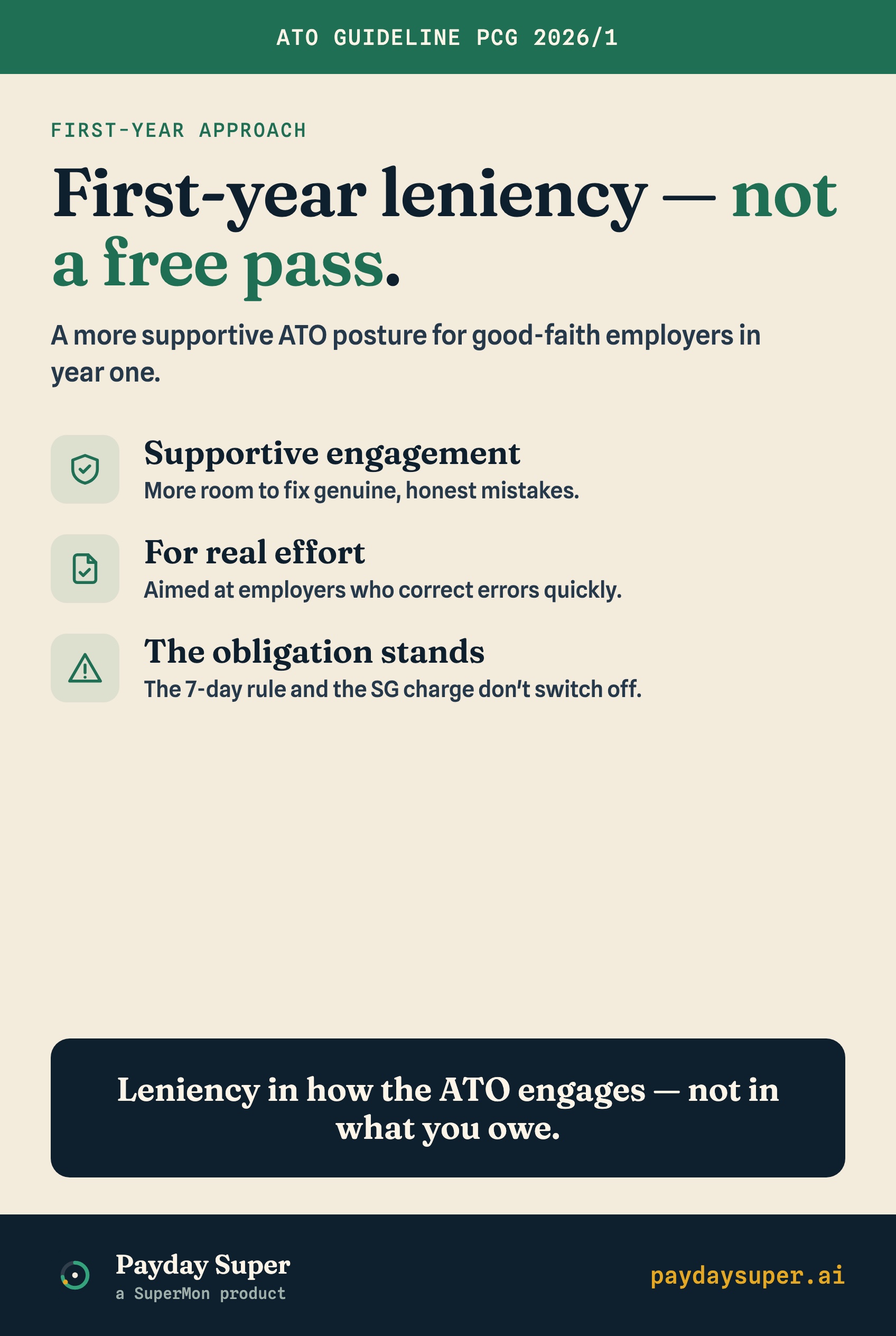
PCG 2026/1 does not give you a free pass. That's the first thing to understand, because the word "leniency" gets read as "exemption", and the gap between those two is where employers get caught.
Here's what the guideline actually is. PCG 2026/1 is the ATO's practical compliance guideline for the first year of Payday Super. It sets a more supportive compliance approach for employers who are genuinely trying to meet the new rules and who fix mistakes quickly. It changes how the ATO engages with good-faith employers. It does not change the law they're complying with.
That distinction runs through everything below.
What is PCG 2026/1?
It's a practical compliance guideline — the kind of document the ATO issues to explain how it will administer a rule, as opposed to the rule itself.
From 1 July 2026, Payday Super requires Super Guarantee (SG) contributions to be received by each employee's fund within 7 business days of payday. That's a big operational shift from the old quarterly rhythm, and the ATO knows employers and their payroll systems need time to adjust.
PCG 2026/1 is the ATO's response to that transition. It signals that, in the first year, the ATO intends to take a supportive posture toward employers who are genuinely attempting to comply and who correct errors promptly. Think of it as guidance on the ATO's compliance behaviour, not a change to your obligations.
What does the "supportive first-year approach" actually mean?
In plain terms: if you're clearly trying to do the right thing and you fix problems fast, the ATO has signalled it will engage with you differently than it would with an employer who ignores the rules.
What it looks like in practice is a softer compliance footing — more room to correct genuine errors during the bedding-in period without the full weight of enforcement landing immediately on a good-faith mistake.
What it does not look like is the ATO waving through late super. The contribution is still late. The clock still ran. The supportive approach is about how the ATO deals with you when something goes wrong, not about pretending nothing did.
What does PCG 2026/1 NOT do?
This is the section to read twice. The guideline does not:
- Remove the obligation. Super still has to be received by the fund within 7 business days of payday. The deadline is unchanged.
- Switch off the Super Guarantee Charge. Late payments can still trigger the SGC — the super shortfall, nominal interest, and an administration component, calculated on total salary and wages and not tax-deductible. A "supportive approach" is not the same as "no charge".
- Change the rate or the mechanics. SG is still 12% of ordinary time earnings, paid to the same funds. Payday Super changed the timing; PCG 2026/1 doesn't change anything about that.
- Cover employers who don't act. If you ignore the rules, or sit on a known error, the guideline isn't built to protect you. It's aimed at the opposite behaviour.
Treat it as leniency in engagement, not leniency in obligation.
Who is PCG 2026/1 aimed at?
Employers who are genuinely attempting to comply and who correct mistakes quickly.
That's the test, in spirit. Two behaviours sit at its core:
- Genuine attempt. You've set up systems to pay on time, you understand the 7-business-day rule, and you're acting on it across your pay runs.
- Prompt correction. When something slips — a bounced payment, a missed starter, a processing delay — you find it and fix it fast, rather than waiting for the ATO to notice.
The further your behaviour sits from those two, the less the supportive approach is meant to help. An employer making a good-faith error during the transition is the intended audience. An employer who never set anything up, or who knows about a shortfall and does nothing, is not.
What should my practice document to demonstrate genuine effort?
If the supportive approach turns on whether you genuinely tried and corrected quickly, then your records are what show it. Keep contemporaneous evidence — created at the time, not reconstructed later.
Here's a practical checklist for an accounting or bookkeeping practice:
- Your deadline-tracking system. Show that every client's pay runs have their 7-business-day deadline tracked, not estimated from memory.
- The buffers you build in. Document that you aim for contributions to arrive well before day 7, accounting for fund processing time, since "received" is what counts.
- Fund-detail validation. Keep a record of checking super fund details, USIs and member numbers — especially for new starters — before payday, so payments don't bounce.
- The SBSCH transition. If clients used the Small Business Super Clearing House (which closes 30 June 2026), document the replacement you put in place and when it was tested.
- Error logs and fix times. When something goes wrong, record what happened, when you caught it, and how quickly you corrected it. The speed of correction is the behaviour the guideline rewards.
- Client communication. Keep evidence that you flagged the new rules to clients and explained what changed.
None of this is busywork. It's the difference between saying you acted in good faith and being able to show it.
How this fits with day-to-day compliance
The honest read on PCG 2026/1 is that it lowers the temperature for the first year — but only for employers whose actual behaviour backs up the claim of good faith. The way you earn that posture is the same way you'd avoid trouble anyway: track every deadline, pay early enough to land on time, validate details, and correct fast when something slips.
That's a continuous-monitoring habit more than a one-off setup. SuperMon connects to Xero today (read-only — it reads pay runs, it can't move money or change payroll), with MYOB coming soon. It tracks each client's 7-business-day deadline and alerts before anyone is late, and it leaves a record of those deadlines and your responses along the way. If the ATO ever asks whether you were genuinely trying to comply, that record is the answer.