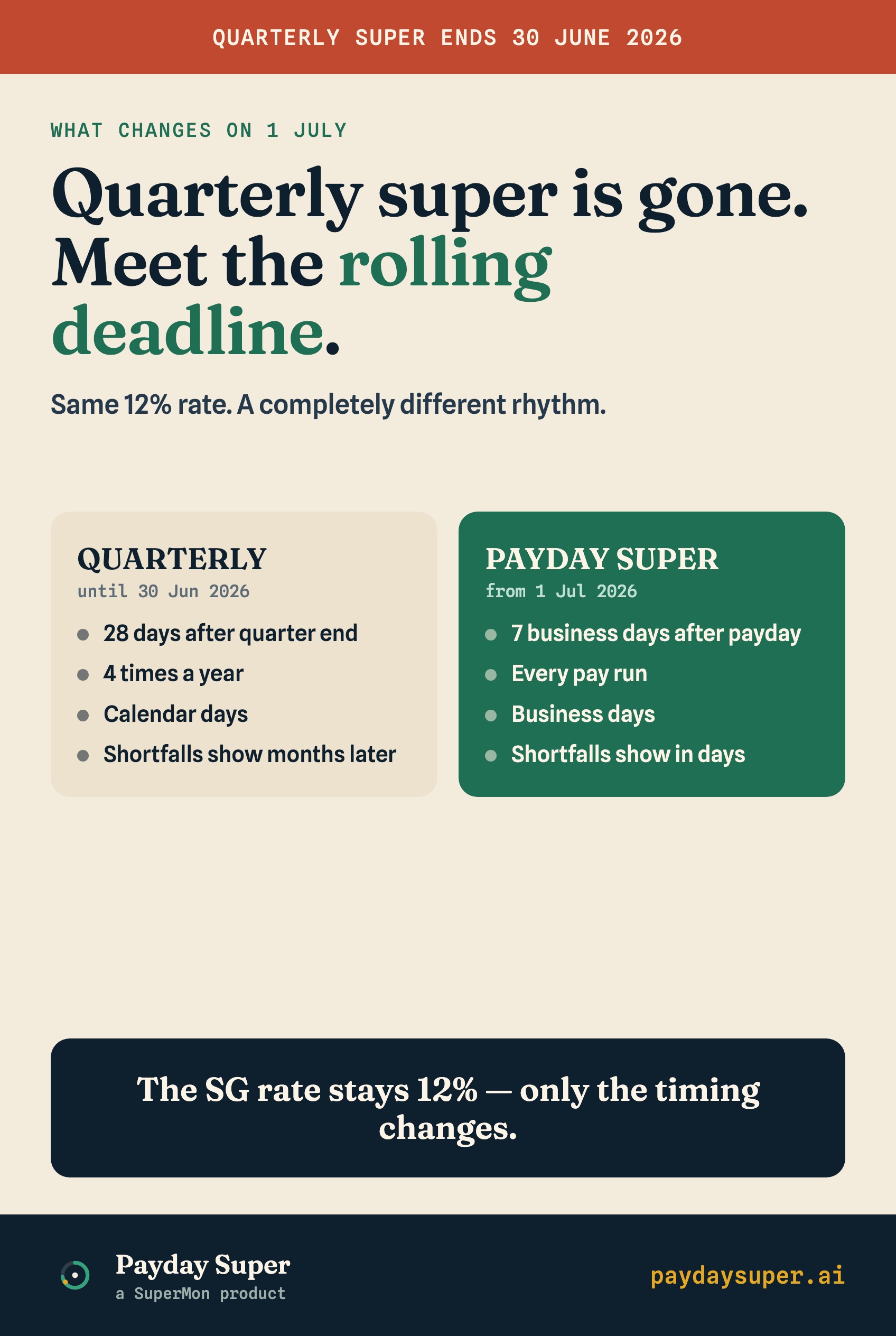
For wages paid up to 30 June 2026, the old quarterly Super Guarantee deadlines still apply. For wages paid from 1 July 2026, Payday Super takes over and super must reach the employee's fund within 7 business days of each payday. The rate stays at 12% and your funds don't change. What changes is the deadline, the frequency, how you count the days, and how quickly a missed payment becomes visible.
Here is the side-by-side, plus what your practice actually has to change.
How did quarterly super work?
Under the quarterly system, employers paid Super Guarantee up to 28 days after the end of each quarter. Pay your staff in July and the matching super wasn't due until late October. That gap was the whole problem the reform targets: unpaid super could accumulate for months before anyone noticed.
Quarterly deadlines were calendar dates, four times a year, and easy to batch. Many small employers used the Small Business Super Clearing House (SBSCH) to distribute payments. That world ends with the changeover.
What does Payday Super require instead?
From 1 July 2026, super must be received by the employee's fund within 7 business days of payday. Not sent — received. Business days exclude weekends and national public holidays, so the window is never 7 calendar days.
The trigger is the pay event itself. Single Touch Payroll (STP) reports each pay event to the ATO, and under Payday Super each reported pay event effectively starts a 7-business-day super clock. Pay weekly and you start roughly 52 clocks a year instead of meeting 4 quarterly deadlines.
Payday Super vs quarterly super: side by side
| Quarterly super (to 30 June 2026) | Payday Super (from 1 July 2026) | |
|---|---|---|
| Deadline | 28 days after quarter end | Received by fund within 7 business days of payday |
| Frequency | 4 times a year | Every payday |
| Day counting | Calendar days from quarter end | Business days from payday; weekends and national public holidays excluded |
| Sent vs received | Payment timing managed quarterly | Must be received by the fund, not just sent |
| Shortfall visibility | Can sit unnoticed for months | Visible within days of each pay event |
| SG rate | 12% of ordinary time earnings | 12% of ordinary time earnings (unchanged) |
| Clearing house | SBSCH available | SBSCH closes 30 June 2026 |
| Trigger | End of calendar quarter | Each STP pay event |
The rate row is the one to underline for clients who fear a cost increase: it doesn't change. The reform is about timing, not the amount.
What happens during the changeover?
Both rules apply briefly, split by when the earnings are paid.
- Salary and wages paid up to 30 June 2026 fall under the quarterly deadlines. The final quarterly super obligation still needs to be met on its normal timeline.
- Salary and wages paid on or after 1 July 2026 fall under the 7-business-day Payday Super rule.
So a pay run that straddles the date is split by payment date, not by the period worked. Plan the last quarterly payment and the first Payday Super payday as two separate events, and confirm the transition treatment against current ATO guidance. Note too that the SBSCH closes on 30 June 2026, so anyone who relied on it needs an alternative payment route ready before the first compliant payday.
What happens if super is late under the new rule?
Late payment triggers the Super Guarantee Charge (SGC): the shortfall plus nominal interest plus an administration component. It is not tax-deductible, and it is calculated on total salary and wages, not just ordinary time earnings — so the charge can be larger than the super originally owed.
ATO guideline PCG 2026/1 sets a more supportive compliance approach in the first year for employers genuinely trying to comply and fixing mistakes quickly. It softens how the ATO engages, not whether the charge applies. Treat penalty specifics as something to confirm against current ATO guidance rather than assume.
What does your practice need to change operationally?
The work shifts from quarterly batch to continuous.
- Map every client's pay cycle. Weekly, fortnightly and monthly each generate different deadline patterns. Off-cycle runs — bonuses, terminations, back pay — create their own clocks.
- Replace the SBSCH for any client who used it, before 30 June 2026.
- Pay early enough that the fund receives the money inside 7 business days, allowing for clearing-house and SuperStream processing time.
- Build a monitoring routine rather than a quarterly task. A missed deadline now surfaces in days, and there are far more of them.
- Brief clients that the 12% rate and their fund don't change — only the timing — so the conversation is about process, not cost.
- Keep proof of receipt. Because the deadline is the fund's receipt date, file confirmation of when each contribution actually landed. Your payment date alone won't show you met the rule, and it won't help if a fund queries timing later.
A quarterly checklist matched a quarterly rule. Payday Super runs continuously, so monitoring should too. SuperMon connects to Xero today on a read-only basis — it reads pay runs but cannot move money or change payroll — tracks each client's 7-business-day deadline across every pay cycle, and alerts you before anyone is late. MYOB support is coming soon.