Payday Super starts for salary and wages paid on or after 1 July 2026. From that date, every payday starts a 7-business-day clock for super to be received by the employee's fund. For bookkeepers, that turns a quarterly task into a per-pay-cycle obligation across your whole client base.
The rate and the mechanics don't change. SG stays at 12% of ordinary time earnings, and contributions still go through a fund or clearing house. What changes is the timing, and timing is exactly what bookkeepers manage day to day. This is the checklist to get your clients ready and keep them compliant.
What changes for bookkeepers on 1 July 2026?
Three things, practically speaking.
The deadline moves from quarterly to per-payday. The old rule — pay SG within 28 days of quarter end — applies only to earnings paid up to 30 June 2026. After that, super must be received by the fund within 7 business days of each payday. Received, not sent: the clock stops when the money lands, not when you submit it, so clearing house lead times eat into the window.
The Small Business Super Clearing House closes on 30 June 2026, so any client leaning on it needs a new route.
And the cost of slipping rises in visibility. A late payment triggers the Super Guarantee charge — shortfall plus nominal interest plus an administration component — which isn't tax-deductible and is calculated on total salary and wages, not just OTE. It can exceed the super that was owed.
What's the Payday Super checklist for bookkeepers?
Work through this client by client. The order matters: you can't set deadlines for clients you haven't listed, and you can't brief clients on a route you haven't confirmed.
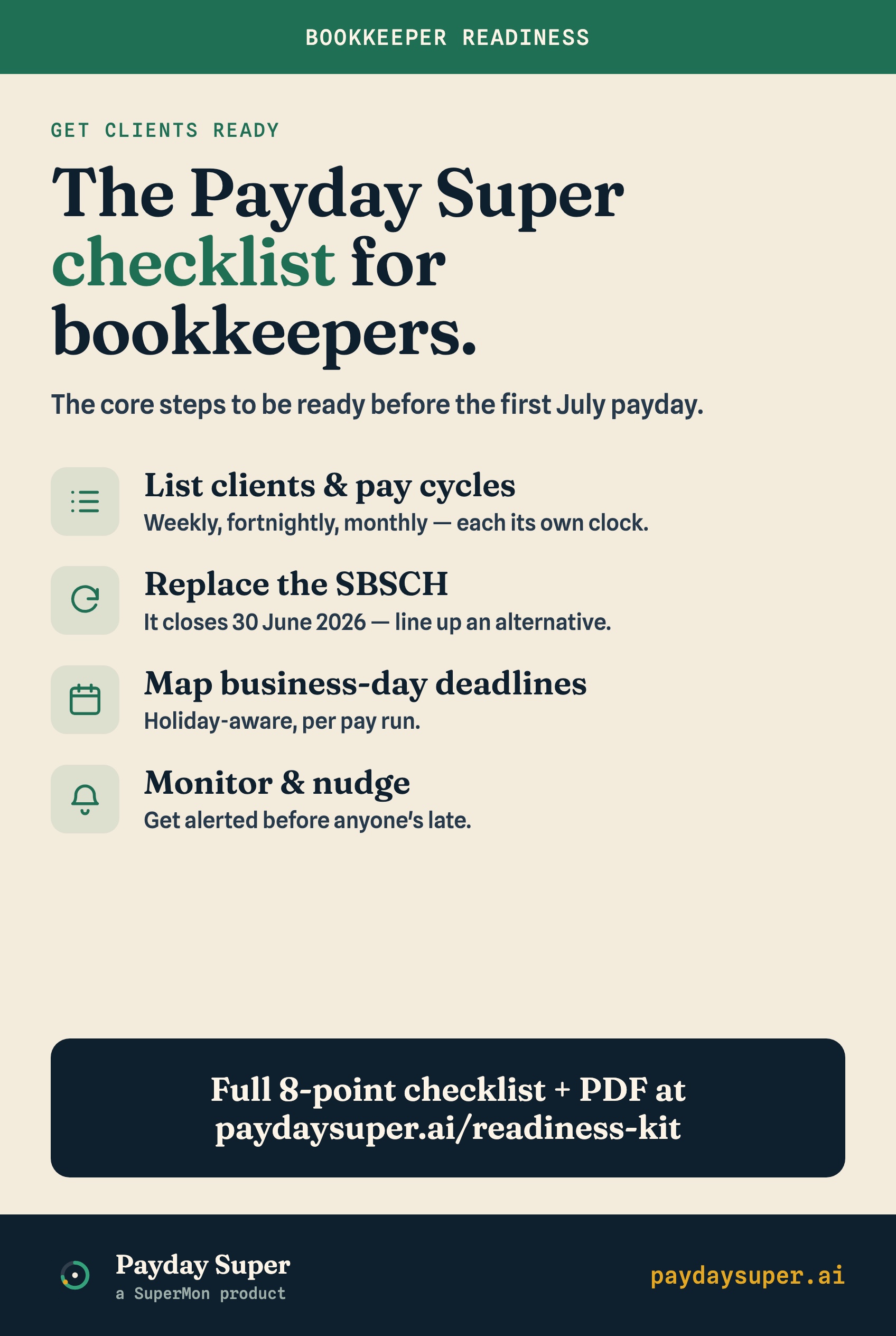
List every client, pay frequency, and current super route. Weekly, fortnightly, monthly — and how super currently reaches their funds. This is your risk map; weekly payers will hit the 7-day deadline most often.
Confirm the post-SBSCH payment route. For any client using the Small Business Super Clearing House, lock in a replacement before 30 June 2026 — a commercial clearing house or their payroll software's super solution. Test it before the first July payday.
Map each client's business-day deadlines. Count 7 business days from each payday, excluding weekends and national public holidays. Flag pay dates that fall near long weekends, where calendar time is shorter than it looks.
Validate fund and stapling details for every employee. Wrong or stale fund details are the most common reason a contribution doesn't land on time. Confirm stapled fund details are current so payments aren't bounced or delayed.
Account for clearing house lead time. Because super must be received within the window, work backwards from the deadline by the clearing house's processing time and set your internal cut-off earlier than the legal deadline.
Brief each client. Tell them the deadline is now per-payday, that funds for paying super must be available at each pay run, and what's expected of them if they run their own payroll. A client who's surprised by the deadline is a client who'll miss it.
Set up monitoring and alerts. Put a watch on every payday's 7-business-day deadline that warns you before it's missed, not a report after. Checking pay runs by memory across a full client base doesn't scale.
Document an escalation process. Decide in advance who's contacted and how fast if a deadline is at risk — and the steps to correct a missed payment quickly, since prompt correction matters under the ATO's first-year approach.
Know PCG 2026/1. Read the guideline so you can advise clients accurately. It's a supportive compliance stance for employers genuinely trying to comply, not an exemption from the deadline or the charge.
If you'd rather start from a structured template, the Readiness Kit packages much of this into a downloadable form you can work through with each client.
How do business days change the deadline maths?
More than people expect. "7 business days" is not 7 calendar days, and the gap widens around public holidays.
Take a Friday payday before a Monday public holiday. The clock skips the weekend and the holiday, so the 7 business days can stretch well past where a naive 7-day count would land — but the reverse risk is the trap. If you mentally treat the deadline as a week, you'll set a cut-off that's already too late once a holiday or clearing house lag is factored in. Always count against a real business-day calendar, then subtract clearing house processing time to get your true internal deadline.
What should I confirm before the first July pay run?
A short pre-flight per client, on top of the main checklist:
- The replacement for the SBSCH is live and has been tested with a real transaction.
- Every employee's fund and stapling details are current.
- Your internal cut-off is set earlier than the legal deadline to cover clearing house lead time.
- The client knows funds must be available at each payday, not at quarter end.
- An alert is in place that fires before any deadline, and someone owns the response.
Why does Single Touch Payroll matter here?
Because STP is effectively what starts the clock. Each pay event you report through STP tells the ATO a payday has occurred, and under Payday Super that same pay event begins the 7-business-day super deadline. The reporting you already do and the new deadline are tied to the same event, which is useful: if your monitoring keys off pay events, every payday is captured automatically rather than relying on someone to remember it.
Across a full client base, the only sustainable way to hold these deadlines is continuous monitoring rather than manual checking. Software that connects to each client's payroll, tracks every payday's 7-business-day deadline against a real business-day calendar, and alerts you before anyone is late turns this checklist from a recurring scramble into a managed, by-exception process. That's the difference between watching the clock yourself and letting it watch itself.